
Axie Infinity: The Rise and Fall of a Blockchain Gaming Pioneer
Why Is Axie Infinity Called a Pioneer of Blockchain Gaming?
Axie Infinity was not the first blockchain game, but it brought NFT pets, card battles, breeding, trading, and the Play-to-Earn economy to a mass audience. For that reason, it is often described as a pioneer of blockchain gaming. At its peak, it introduced millions of users to blockchain. Its SLP inflation, falling entry-asset prices, and the Ronin bridge exploit also made it one of GameFi's most important case studies.
Axie Infinity was developed by Vietnamese game studio Sky Mavis. Players collect, form teams with, battle, and breed digital creatures called Axies. Each Axie exists as an NFT that players can manage and trade through a wallet. The game also uses assets such as AXS and SLP to build an economy that directly connects in-game progress with on-chain markets.
What Kind of Game Is Axie Infinity?
Axie Infinity is a Web3 gaming ecosystem centered on digital pets called Axies. Individual Axies have body parts, attributes, and abilities. Players can form teams for card battles or collect, breed, and upgrade their characters. As the ecosystem expanded, Axie ceased to mean only one battle game and became a game world spanning Origins, Classic, land, and other experiences.
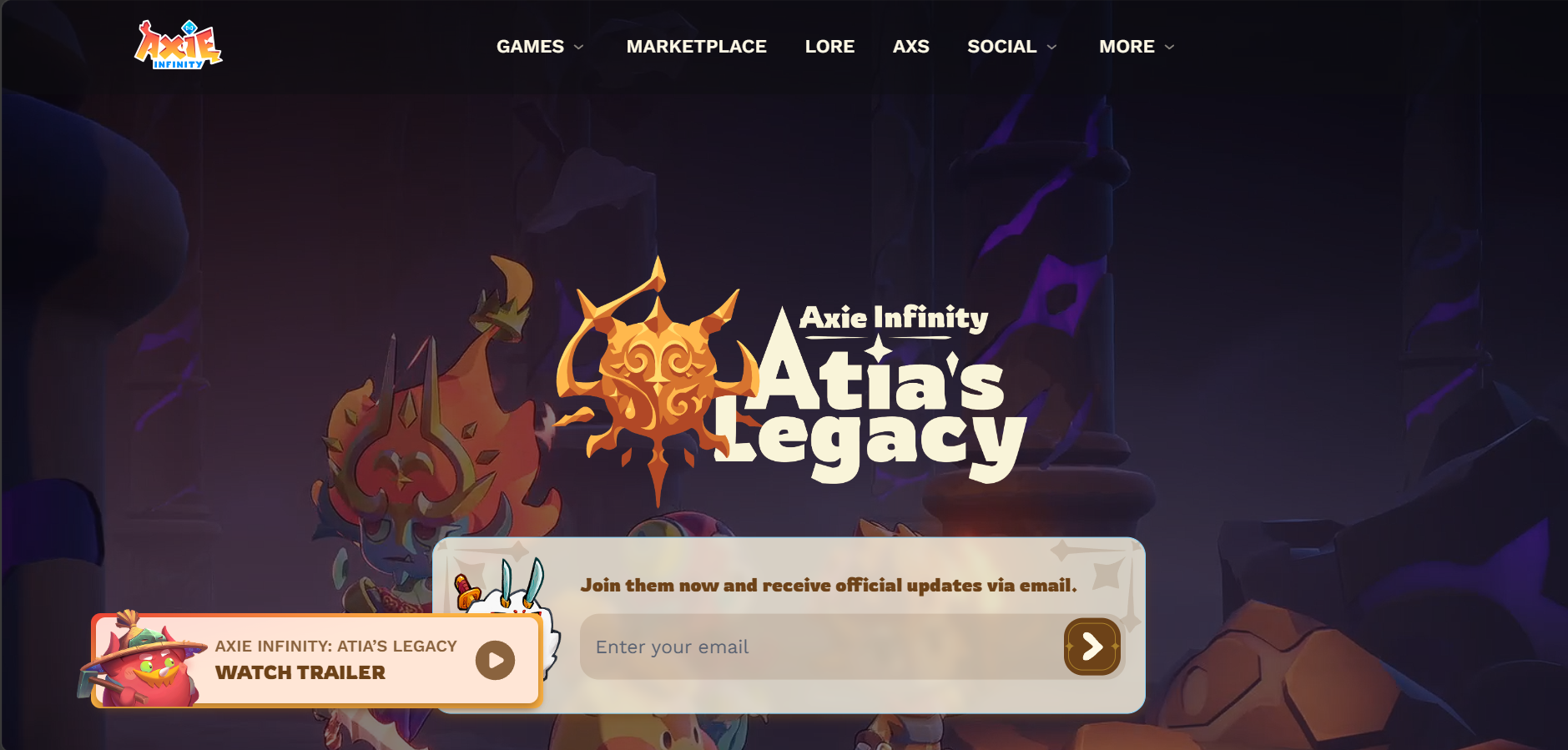
Axie Infinity's official site describes Axies as digital creatures that can be battled, collected, and bred, and says that the related digital collectibles can be used, traded, or used to obtain resources across ecosystem games. Source: Axie Infinity official website This structure, in which a game character is also an on-chain asset, became a design template for many later GameFi projects.
How Did Axie Infinity Develop?
Development of Axie Infinity began in 2018 with the early goal of combining blockchain ownership with digital-pet gameplay. The team later introduced battling, breeding, and marketplace functions, while gradually moving Axie assets to Ronin, a network designed for gaming. In 2021, a rising crypto market, the P2E narrative, and demand for online income during the pandemic jointly drove rapid expansion.
3.1 Early Stage: NFT Pets and a Community Experiment
Early Axie Infinity was closer to an NFT collecting and battling experiment for crypto-native users. Players needed to understand Ethereum wallets, gas fees, and on-chain transactions, creating a high barrier to entry. Rare Axies, body parts, breeding, and marketplace trading helped the team create collecting demand and gradually build a community around game assets.
3.2 Growth Stage: P2E Becomes the Core Narrative
Once players could earn SLP through battles and quests and use the rewards for breeding or trade them in the market, Axie's appeal expanded beyond collecting to the idea that time spent playing could generate digital income. In some regions, guild and scholarship models provided Axie teams to players who did not own the required NFTs, further lowering the participation threshold and accelerating user growth.
3.3 Infrastructure Stage: Migration to Ronin
Ethereum mainnet gas fees and throughput could not support a high volume of frequent game actions. Sky Mavis therefore built Ronin so Axie asset transfers, marketplace trades, and reward claims could settle faster and at lower cost. A dedicated gaming chain improved the user experience but also made ecosystem security more dependent on Ronin validators, bridges, and the team's operations.
Axie's official roadmap records phases of project development and asset migration, including the important milestone when Axies moved to Ronin. Source: Axie Infinity roadmap
What Is Axie Infinity's Core Gameplay?
Axie's core loop consists of collecting, team building, battling, progression, and breeding. Players assemble teams based on Axie attributes, body parts, and card abilities, then complete challenges in PVE or PVP modes. Results can affect rank, experience, and rewards, while character progression, breeding, and marketplace trading connect the gameplay loop to NFTs and the token economy.
- Collect Axies: Players choose Axies based on appearance, parts, abilities, lineage, and rarity.
- Build a team: Multiple Axies form a battle lineup, with strategic interactions among cards and attributes.
- Enter battles: Players gain progress or rewards through adventure, arena, tournament, and other modes.
- Breed characters: Specific resources are used to breed new Axies, adding characters to the ecosystem's supply.
- Trade assets: Players can manage and trade eligible Axie NFTs on the official marketplace.
What Roles Do AXS, SLP, and Axie NFTs Play?
The Axie Infinity economy mainly revolves around Axie NFTs, AXS, and SLP. Axie NFTs are game characters and collectibles. AXS supports the ecosystem, governance, and some game functions, while SLP has long been used in frequent activities such as game rewards, breeding, and crafting. The three affect one another: player demand determines how assets are used, while reward issuance and consumption affect token supply and demand.
5.1 What Is an Axie NFT?
Each Axie is an NFT with distinct attributes and an on-chain record. Players can manage the asset in wallets and on the official marketplace, but owning an Axie does not grant ownership of the game's code or artwork copyrights, nor does it guarantee that the character will always have the same utility. When the team changes battle rules, ability values, or available modes, an Axie's practical in-game value can also change.
5.2 What Is AXS Used For?
AXS is an important token in the Axie Infinity ecosystem and has been used for governance, staking, breeding, and certain reward programs. Its specific uses can change with game versions and ecosystem rules, so players should not judge current rights solely from an early white paper. Research should cover the latest official information, supply unlocks, governance implementation, and market liquidity. The AXS page also provides related market information.
5.3 What Is SLP Used For?
SLP is a resource token more closely connected to game activity. It was historically earned through battles and used to breed Axies, and later expanded into consumption scenarios such as rune and charm crafting. Sky Mavis currently explains that in-game SLP can be claimed on-chain once requirements are met, while on-chain SLP must be deposited into the game before it can be used for some crafting functions. Source: official SLP documentation
Why Did Axie Infinity Grow So Quickly?
No single factor explains Axie's rise. Product design, the market cycle, community organization, and infrastructure worked together. Familiar pet characters made NFTs easier to understand, P2E rewards attracted income-oriented players, Ronin reduced on-chain operating costs, and guild and scholarship models helped more people obtain entry assets.
6.1 Game Assets Had Clear Utility
Axie NFTs were not merely static images; they were game characters used in battles, team compositions, progression, and breeding. Players could directly see how an asset affected gameplay, making the concept easier to explain than a purely collectible NFT. Differences in character attributes also created several layers of demand around strategy, rarity, and market value.
6.2 Rewards Created a Clear Participation Incentive
P2E allowed players to turn quest and competitive outcomes into tradable rewards. When token prices were rising and new players kept arriving, the fiat value of those rewards was highly attractive. However, that growth also tied user retention to asset prices. Once returns fell, income-oriented players could leave just as quickly.
6.3 Guilds Expanded Player Access
Under the scholarship model, asset owners or guilds supplied Axies, while players played the game and shared rewards under agreed terms. This reduced the entry barrier created by expensive NFTs and gave rise to training, team management, and cross-regional communities. Players nevertheless faced opaque revenue splits, account-control issues, and volatile earnings.
6.4 Ronin Improved the On-Chain Experience
High-frequency games cannot afford high Ethereum gas fees for every action. Ronin offered Axie an execution environment better suited to game assets and marketplace trading, improving the wallet, reward, and NFT trading experience. It showed that dedicated blockchains could help Web3 games scale, but it also introduced new risks around bridges and validator concentration.
Why Did Axie Infinity's Economic Model Come Under Pressure?
The core problem was that rewards and the Axie supply could grow faster than real demand for the game. When large numbers of players earned SLP through battles and preferred to sell their rewards, the market needed continuous breeding, crafting, and new-player demand to absorb the supply. Once new-user growth slowed or expected returns fell, selling could exceed consumption, putting both tokens and entry assets under pressure.
7.1 Why Did SLP Issuance Create Selling Pressure?
As a frequently issued reward asset, SLP needs sustained consumption through breeding, crafting, or other functions. If daily issuance exceeds real use, players' accumulated SLP reaches the market. As the price falls, the same play time produces less income. Income-oriented players may play longer or leave, and either response can further alter the economic balance.
7.2 Why Did the Number of Axies Affect Entry Prices?
Breeding creates new Axies, supplying characters to new players while increasing the total NFT supply. During the growth stage, new-user demand could absorb those Axies. After growth slowed, ordinary Axie prices could fall if breeding volume and willingness to sell remained high. Rare assets and useful characters could also be affected by lower liquidity across the market.
7.3 Why Were High Returns Hard to Sustain?
If rewards mainly come from token issuance and asset purchases by new players, returns depend on continuous growth. When the market can no longer expand at the same rate, a project must reduce rewards, increase consumption, or find new revenue sources. Every adjustment affects player income and asset valuations, so economic reforms often bring controversy and user attrition.
Axie's official economic documentation acknowledges the need to balance AXS, SLP, and the Axie supply over the long term. It discusses managing ecosystem sustainability through resource sinks, content, and economic parameters. Source: Axie population and long-term sustainability

What Does Axie Infinity's Rise and Fall Tell Us?
Axie's rise and fall was not simply a change in token prices. It was a systemic shift caused when user motivation tilted away from game experience and toward expected earnings. In a rising market, high rewards attracted new players and raised demand for entry assets. When the market weakened, rewards, player growth, and NFT prices could fall together, creating a stronger economic feedback loop than in a conventional game.
Axie also showed why active users cannot be measured by wallet addresses or reward claims alone. If one person manages several accounts, or players join only to sell rewards, on-chain transaction activity can exceed genuine entertainment demand. Evaluating GameFi therefore requires looking at play time, content updates, non-reward-driven players, spending use cases, and competitive communities rather than token volume alone.
What Happened in the 2022 Ronin Bridge Incident?
In March 2022, the bridge connecting Ronin and Ethereum was exploited. Attackers used compromised validator authority to make unauthorized asset transfers. The FBI later confirmed that North Korea-linked Lazarus Group and APT38 were responsible for the theft of approximately $620 million in crypto assets. The incident became a defining example of infrastructure risk in blockchain gaming.
The FBI's official statement, released in April 2022, formally attributed the attack. The event showed that even when a game and its NFT contracts operate normally, bridges, validator keys, and operational privileges can still become single points of failure for the entire economic system.
What Security Problems Did the Ronin Incident Expose?
The central lesson from Ronin is that low fees and high throughput cannot come at the cost of excessive control concentration. Bridges lock large amounts of assets. If validator keys, signature thresholds, or operating systems are compromised, attackers may bypass normal user actions and directly transfer bridge funds. Game players therefore assume infrastructure risks beyond the game's own contracts.
- Validator concentration: Too much signing authority controlled by a small number of entities magnifies key-theft and insider risks.
- Residual temporary permissions: Temporary access granted to solve a performance problem can become a persistent attack path if it is not revoked promptly.
- Concentrated bridge funds: Locking substantial collateral in one contract makes a bridge a high-value target.
- Insufficient anomaly monitoring: Losses can grow if large transfers do not promptly trigger alerts and a pause.
- Gaming-finance coupling: An infrastructure attack simultaneously affects withdrawals, market confidence, and game-asset liquidity.
Security firm Halborn's analysis documents compromised validator keys, temporary permissions that were not revoked, and inadequate anomaly monitoring, providing additional context for the attack path. Source: Halborn analysis of the Ronin hack
What Changes Did Axie Infinity Make Afterwards?
Following the economic and security incidents, Axie gradually moved beyond a single P2E narrative toward a broader gaming ecosystem. The team adjusted SLP issuance and sinks, updated Origins and Classic, introduced Axie experience and levels, developed land-related experiences and more ecosystem games, and improved wallet and reward-claiming processes. The objective was to make Axie utility and player relationships less dependent on daily token earnings.
11.1 From Reward-First to Gameplay-First
Newer versions place more emphasis on free entry, card strategy, seasonal content, and character progression, allowing players without expensive NFTs to experience the core gameplay. Rewards still exist, but they should not be the only reason users stay. This change follows the wider GameFi shift from Play-to-Earn toward Play-and-Earn.
11.2 Adding Long-Term Axie Progression
Axie experience points, or AXP, together with levels, evolution, and crafting systems, are intended to help players form longer-term relationships with specific Axies. Sky Mavis explains that AXP can be earned through multiple Axie game experiences and that some level progress is synchronized into on-chain attributes. Source: AXP and Axie levels
11.3 Expanding the Game and Creator Ecosystem
The official ecosystem is no longer limited to one battle mode. As of 2026, Axie's official site lists Origins, Classic, Terrariums, Atia's Legacy, and third-party Axie games. This reflects the team's attempt to expand Axie from one P2E product into a multi-game character and community ecosystem. Source: Axie Infinity official website
Is Axie Infinity Still a Play-to-Earn Game?
Axie still has on-chain economic functions involving AXS, SLP, NFTs, leaderboards, and tournament rewards, but the early P2E label no longer describes it completely. Rewards, entry requirements, and asset utility differ by game version. Some progression resources are first recorded in-game and synchronized on-chain only after requirements are met. Players should verify the rules of the current mode instead of relying on 2021 earnings data.
Sky Mavis help documentation updated in 2026 says that AXS or SLP earned through Axie Classic arenas, leaderboards, tournaments, guild rewards, and other activities must be claimed through the current withdrawal process. Some assets may also be subject to review, conversion, or wallet-selection requirements. Source: Axie Classic AXS/SLP withdrawals
What Did Axie Infinity Bring to the GameFi Industry?
Axie's greatest industry contribution was proving that a blockchain game could build a genuine global player network, asset market, and community organization. It advanced dedicated gaming chains, NFT marketplaces, guilds, scholarships, and player economies. It also taught developers that token rewards, character supply, security infrastructure, and game experience must be designed as one system.
13.1 It Proved On-Chain Game Assets Could Form a Market
Axie NFTs allowed players to independently manage and trade characters and verify their provenance, demonstrating the feasibility of putting game items on-chain. Axie's price changes also showed that on-chain ownership does not guarantee value preservation. For more on the boundaries between ownership and utility, see On-Chain Game Assets: Why Your Game Items Should Be On-Chain.
13.2 It Accelerated Blockchain Gaming Guilds
Scholarships enabled guilds to allocate assets, train players, and distribute earnings, creating a new organizational model for GameFi. At the same time, the model exposed problems involving revenue splits, account control, and labor relationships. Guilds can lower asset barriers, but they cannot eliminate token inflation or the risk of a project shutting down.
13.3 It Redefined Game-Economy Risk
Traditional game economies mainly affect virtual items and player experience. GameFi economies connect directly to public markets. When reward tokens, NFTs, and cross-chain assets are tradable, game-parameter changes can affect real money. Development teams must balance gameplay while also managing financial security, market liquidity, and community-governance pressures.
What Is Hotcoin's Five-Stage Axie Case Model?
Hotcoin Learn summarizes Axie's development in five stages: product validation, incentive-driven growth, expansion at scale, economic contraction, and ecosystem rebuilding. The model is not a price-prediction tool. It helps researchers identify a GameFi project's stage by asking whether growth comes from game demand or token subsidies, and whether economic pressure reflects a short market cycle or a structural supply-demand imbalance.
- Product validation: NFT pets, battles, and breeding demonstrate that on-chain assets can serve real gameplay.
- Incentive-driven growth: SLP, AXS, and asset trading attract players, guilds, and capital.
- Expansion at scale: Ronin reduces transaction costs while players, assets, and market activity grow rapidly.
- Economic contraction: As new demand falls, reward inflation, NFT depreciation, and user attrition reinforce one another.
- Ecosystem rebuilding: New games, free entry, progression systems, and security improvements reduce dependence on a single P2E model.
When researching another GameFi project, the five-stage model can test whether the team is building content and resource sinks during the reward-driven growth phase. If a project only expands token issuance and NFT supply without creating stable player retention, short-term parameter changes usually struggle to restore demand after economic contraction begins.
How Should Axie Infinity Be Analyzed Today?
A current analysis should examine the game ecosystem, AXS, SLP, Axie NFTs, and the Ronin network separately. They are related, but each has different value drivers and risks. Continued official updates and new Axie experiences do not mean historical prices or returns will recover. Continued operation of the project also cannot eliminate token volatility, asset-liquidity risk, or infrastructure risk.
- Game activity: Check whether Origins, Classic, and other experiences receive continuing updates and retain real players.
- SLP supply and demand: Compare reward issuance with crafting and breeding consumption to determine whether selling pressure comes from structural inflation.
- AXS utility: Verify current governance, staking, game functions, unlock schedules, and market demand.
- Axie NFTs: Analyze character utility, rare traits, bid-ask spreads, and completed sales rather than only floor prices.
- Ronin security: Review bridges, validators, wallets, and official announcements without ignoring changes to the underlying network.
- Team delivery: Compare the roadmap with launched products to distinguish long-term development from short-term promotion.
How Can Beginners Try Axie Infinity Safely?
Beginners should download the game, create an account, and connect a wallet only through official Axie Infinity and Sky Mavis entry points. They should not install clients from links in private messages, group chats, or search advertisements. Free characters or low-cost modes can be used to experience the gameplay before buying an Axie NFT. Any expected reward must be recalculated using current rules and withdrawal conditions.
- Use the official website: Verify the axieinfinity.com and app.axieinfinity.com domains and official support-page domain.
- Understand game versions: Distinguish asset and reward rules for Origins, Classic, land, and third-party games.
- Create a separate wallet: Separate the game-interaction wallet from long-term holdings and deposit only the planned amount.
- Try the game for free first: Do not buy an expensive Axie based only on historical earnings or high-priced sales.
- Verify claim conditions: Check whether rewards remain in-game, when they can be claimed, whether review is required, and what fees apply.
- Test with a small transaction: Use a small amount to verify the network and address before a first purchase, bridge transfer, or withdrawal.
- Review contract approvals: Revoke unnecessary asset permissions after you stop using a marketplace or DApp.
What Are the Main Risks of Axie Infinity?
Axie Infinity combines risks from game operations, tokens, NFTs, wallets, and Ronin infrastructure. Players may suffer losses because of economic-parameter changes, SLP inflation, AXS volatility, lower Axie liquidity, or security incidents. Even if the game continues operating, not every asset will necessarily regain its historical price or produce long-term returns.
- Reward inflation: If game resources such as SLP are issued faster than they are consumed, persistent selling pressure may result.
- NFT liquidity: An Axie's listing price is not necessarily an executable price, and ordinary characters may have few active buyers.
- Rule changes: Battle values, rewards, withdrawals, breeding, and crafting costs can all change between versions.
- Cross-chain risk: Transfers between Ronin and other networks depend on bridges and their security mechanisms.
- Wallet phishing: Fake marketplaces, fraudulent rewards, and malicious approvals can lead to stolen on-chain assets.
- Historical anchoring: Using peak 2021 prices and earnings to project the future can understate changes in market structure.
Axie Infinity FAQ
18.1 Was Axie Infinity the First Blockchain Game?
No. Blockchain games such as CryptoKitties appeared before Axie Infinity. Axie is called a pioneer mainly because it combined NFT characters, P2E rewards, a dedicated gaming chain, guilds, and a large-scale player economy, broadly influencing later GameFi products—not because it was chronologically first.
18.2 Can You Still Make Money Playing Axie Infinity?
Some Axie game modes may still offer AXS, SLP, or other rewards, but they do not guarantee a net profit. Outcomes depend on current version rules, performance, claim conditions, token prices, NFT costs, liquidity, and time invested. Any earnings calculation should use current rules rather than data from the 2021 peak.
18.3 Why Did Axie Infinity Decline?
Axie's decline resulted from several interacting factors: a weaker crypto market, SLP reward inflation, slower new-user growth, falling Axie asset prices, and the difficulty of sustaining high returns. The Ronin bridge exploit further damaged confidence in security. The project did not stop operating, but its early reward-driven growth structure changed.
18.4 What Is the Difference Between AXS and SLP?
AXS is more closely associated with the Axie ecosystem, governance, and some game functions. SLP functions more like a frequently used game resource and reward, with uses in breeding, crafting, and related activities. The two tokens have different supplies, utilities, and risks, and their rules can change. Players should check current official documentation rather than treating old white papers or historical returns as current conditions.
18.5 Do Axie NFTs Still Exist After the Ronin Exploit?
The Ronin bridge exploit mainly affected assets locked in and transferred across the bridge; it did not mean that every Axie NFT simultaneously disappeared from the blockchain. The incident nevertheless affected withdrawals, market liquidity, and user confidence. It also showed that on-chain assets depend on several infrastructure layers—including wallets, networks, bridges, and game services—not only the NFT contract.
How Can a Web3 Wallet Be Used to Manage Axie-Related Assets?
Before managing Axies, AXS, SLP, or other GameFi assets, confirm their network and official contract addresses. Verify the domain, signing message, and scope of approval before connecting to a game or marketplace. For bridge transfers or withdrawals, test with a small amount and confirm receipt first. Never give anyone a seed phrase, private key, or wallet recovery password.
You can use Hotcoin Web3 Wallet to manage multi-chain assets and interact with DApps, or download the Hotcoin App to explore related Web3 services.
Conclusion
Axie Infinity's history captures both the opportunities and limitations of first-generation GameFi. It proved that NFT characters, on-chain markets, and player economies could support a product at scale. It also demonstrated how difficult it is to sustain high rewards, continuous issuance, and dependence on new users. The Ronin incident further showed that a game economy's security boundary includes validators, wallets, and bridges.
Axie's significance lies not only in the prices and user records it once achieved, but also in the complete experiment it provided the industry—from product validation and incentive-driven growth to economic contraction, followed by gameplay and ecosystem rebuilding. When researching Axie or another blockchain game, examine game demand first, token economics second, and asset liquidity and infrastructure security last.
For a deeper comparison of P2E and P&E designs, read GameFi's Core Models: Play-to-Earn and Play-and-Earn. GameFi Blockchain Games: The New Play-and-Earn Economy provides a broader framework.
Visit the Hotcoin website for more educational content about GameFi, NFTs, and Web3.
Risk warning: This article is for educational and informational purposes only and does not constitute investment, legal, or tax advice. AXS, SLP, and Axie NFTs may be highly volatile and are subject to liquidity, game-rule, operational, smart-contract, wallet, and bridge risks. Conduct independent research and proceed cautiously before participating.
Recommended
View more

Service@hotcoin.com
Product@hotcoin.com
Business@hotcoin.com
Casecn@hotcoin.com