
API Key Security: Least Privilege and IP Allowlisting
An API key is a credential that lets software access a trading account. Secure management starts with granting only the permissions required, restricting requests to approved IP addresses, storing secrets separately, and making every key independently revocable.
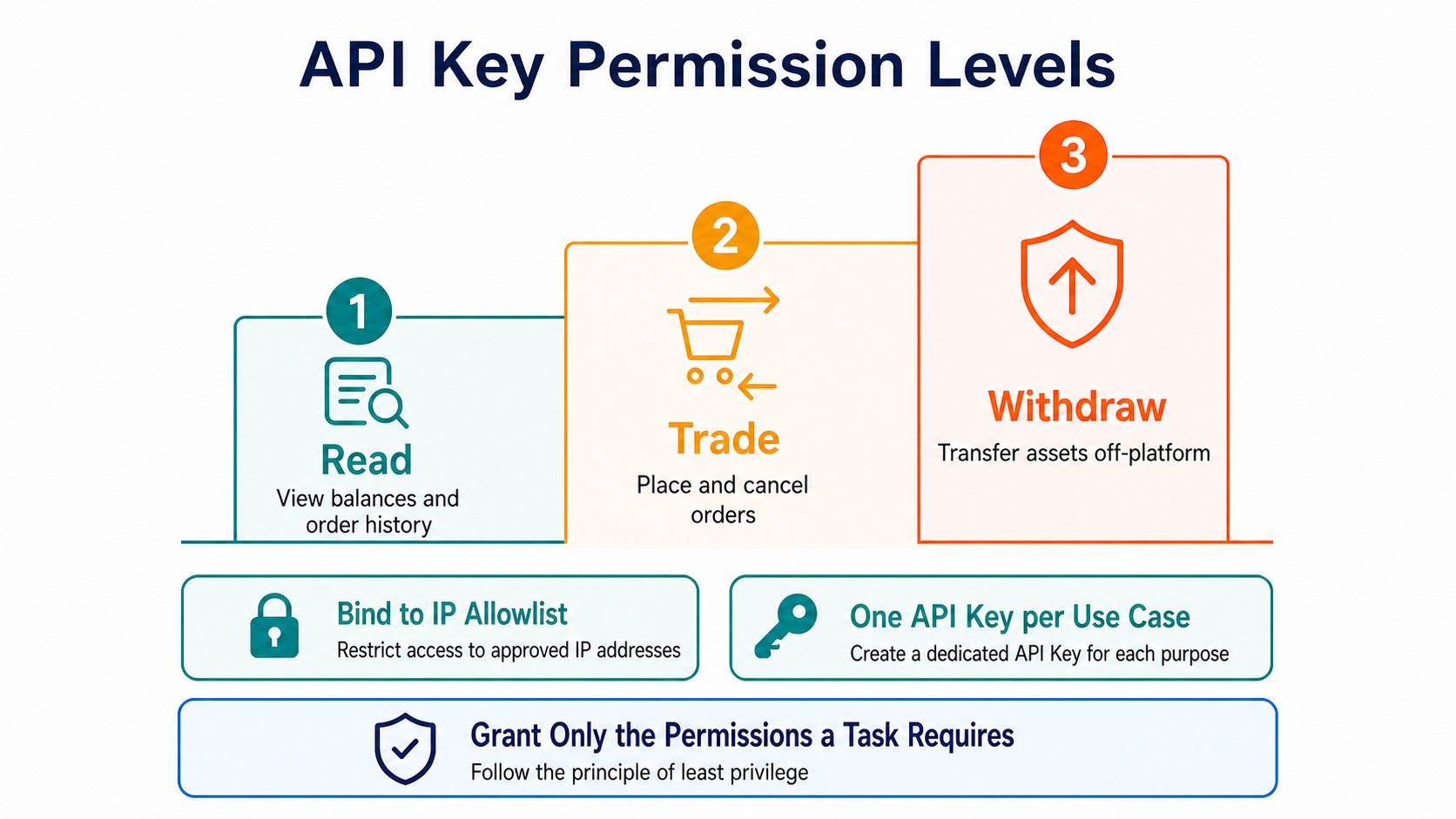
Separate the Permissions First
Read access is generally used to retrieve balances, orders, and market data. Trading access allows orders to be placed and canceled. Withdrawal or transfer access can move assets out of the account. Names and permission boundaries vary by platform, so review the current description of every option before creating a key.
A market dashboard that only needs public prices should not require an account key at all. If it needs personal position data, create a dedicated read-only key. Use a separate key for a trading bot and disable withdrawals. Consider withdrawal access only for a clearly defined treasury system, with additional address restrictions, amount limits, and manual approval.
How Does an IP Allowlist Reduce Risk?
After IP restrictions are enabled, the platform accepts requests only from approved addresses. Even if the key leaks, an attacker must also control an approved server or bypass the network restriction, making exploitation more difficult.
Allowlisting works best for servers with a fixed outbound IP. Home broadband, mobile networks, and cloud jobs without fixed addresses may change frequently; do not use an overly broad network range merely for convenience. With proxies, containers, and multi-region deployments, confirm which outbound address the platform actually sees.
Hotcoin's current API settings page lets users select read, trading, and withdrawal permissions separately and recommends binding IP addresses. The page states that each key can bind up to 10 IP addresses and that a key without an IP binding is valid for 90 days. Product rules may change, so rely on the information displayed on the account page when creating a key.
Where Should Keys Be Stored?
A secret should never be placed in source code, a frontend page, chat messages, screenshots, logs, or a public repository. Production systems should use a dedicated secrets manager or tightly restricted environment variables, with access limited to the processes and people that genuinely need it.
Use different keys for development, testing, and production. Give a third-party bot its own dedicated key instead of sharing the main account credential with the provider. When you stop using the service, delete the key on the exchange first, then remove it from the provider's configuration.
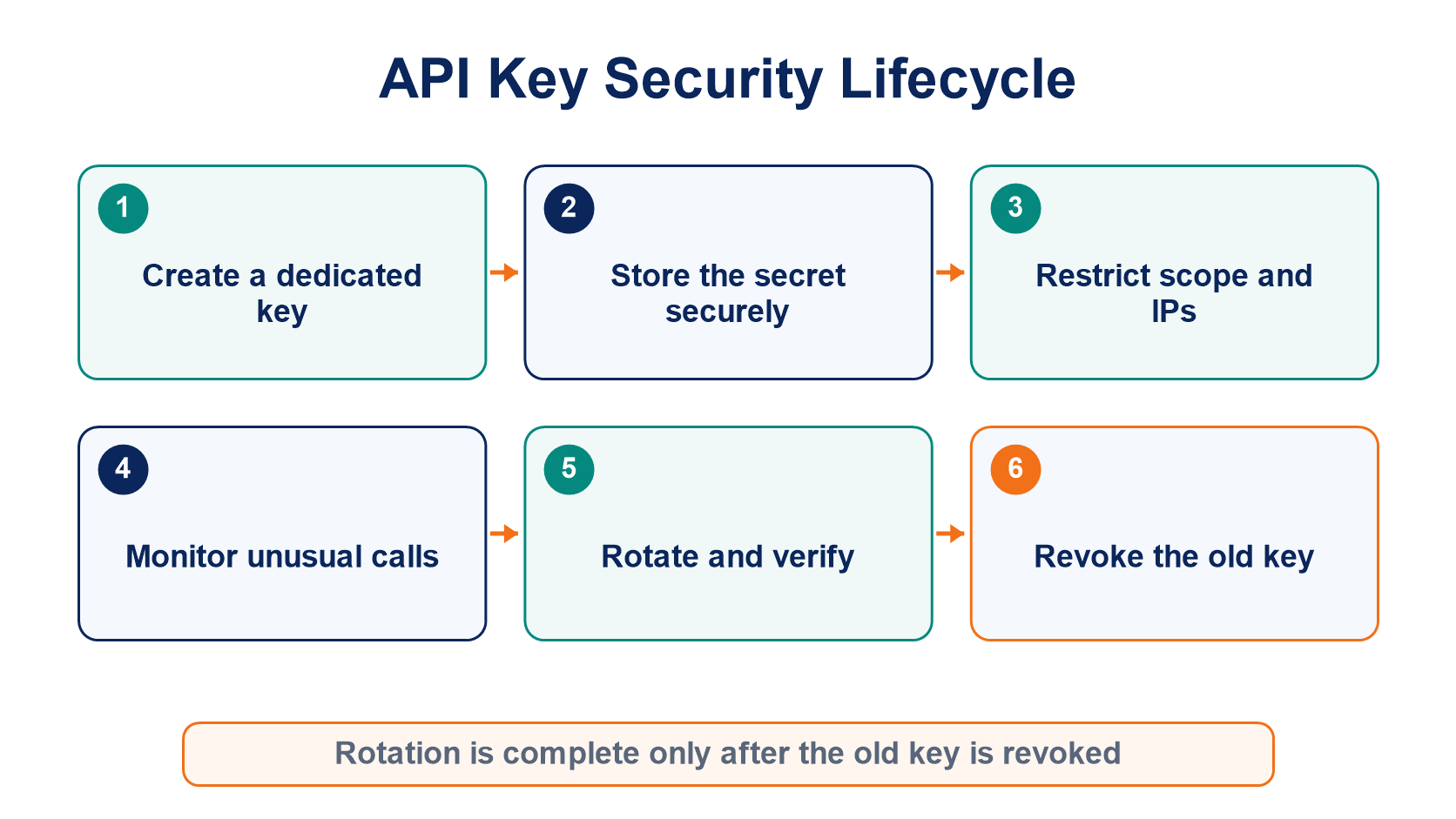
Build an Auditable Lifecycle
For every key, record its purpose, owner, permissions, IP addresses, creation date, and last-used time. Monitor unfamiliar IP addresses, unusual trading pairs, request spikes, off-hours activity, and repeated signature failures. Delete idle keys instead of retaining them indefinitely.
When rotating a key, create the replacement first, validate it in a controlled environment, switch the application, and then delete the old key. Merely changing the secret in the code without deleting the old key on the platform leaves the exposure in place.
How Should You Respond to a Suspected Leak?
The first step is to delete or disable the affected key on the platform rather than waiting for application logs to confirm the incident. Next, revoke suspicious sessions, change the account and email passwords, and inspect withdrawal allowlists, orders, fills, internal transfers, and subaccounts.
If the key has trading access, an attacker may create abusive fills in illiquid markets. Losses can occur even without withdrawal permission. Preserve the key identifier, timestamps, IP addresses, orders, and trade records, and contact the platform through an independently verified official channel.
To protect against spoofed notifications, read about anti-phishing codes. For broader account protection, return to cryptocurrency security fundamentals.
Frequently Asked Questions
Is There No Risk of Loss If a Leaked API Key Cannot Withdraw Funds?
No. Trading access can be abused to place malicious orders, manipulate illiquid assets, or close positions. Even read-only access can expose balances and strategy information.
Can an IP Allowlist Use a Domain Name?
Most platforms require an IP address or network range and do not continuously resolve domain names. Check the platform's current format and confirm whether the cloud service's outbound address is stable.
Can Multiple Bots Share One API Key?
It is not recommended. Separate keys let you limit permissions, distinguish logs, and revoke access independently. Sharing makes abnormal sources and responsibility harder to identify.
Does Regular Rotation Automatically Invalidate the Old Key?
No. You must explicitly delete or disable the old key on the platform and confirm that old applications, backups, and third-party services no longer use it.
Recommended
View more


Service@hotcoin.com
Product@hotcoin.com
Business@hotcoin.com
Casecn@hotcoin.com