
What Is the Ethereum Fusaka Upgrade?
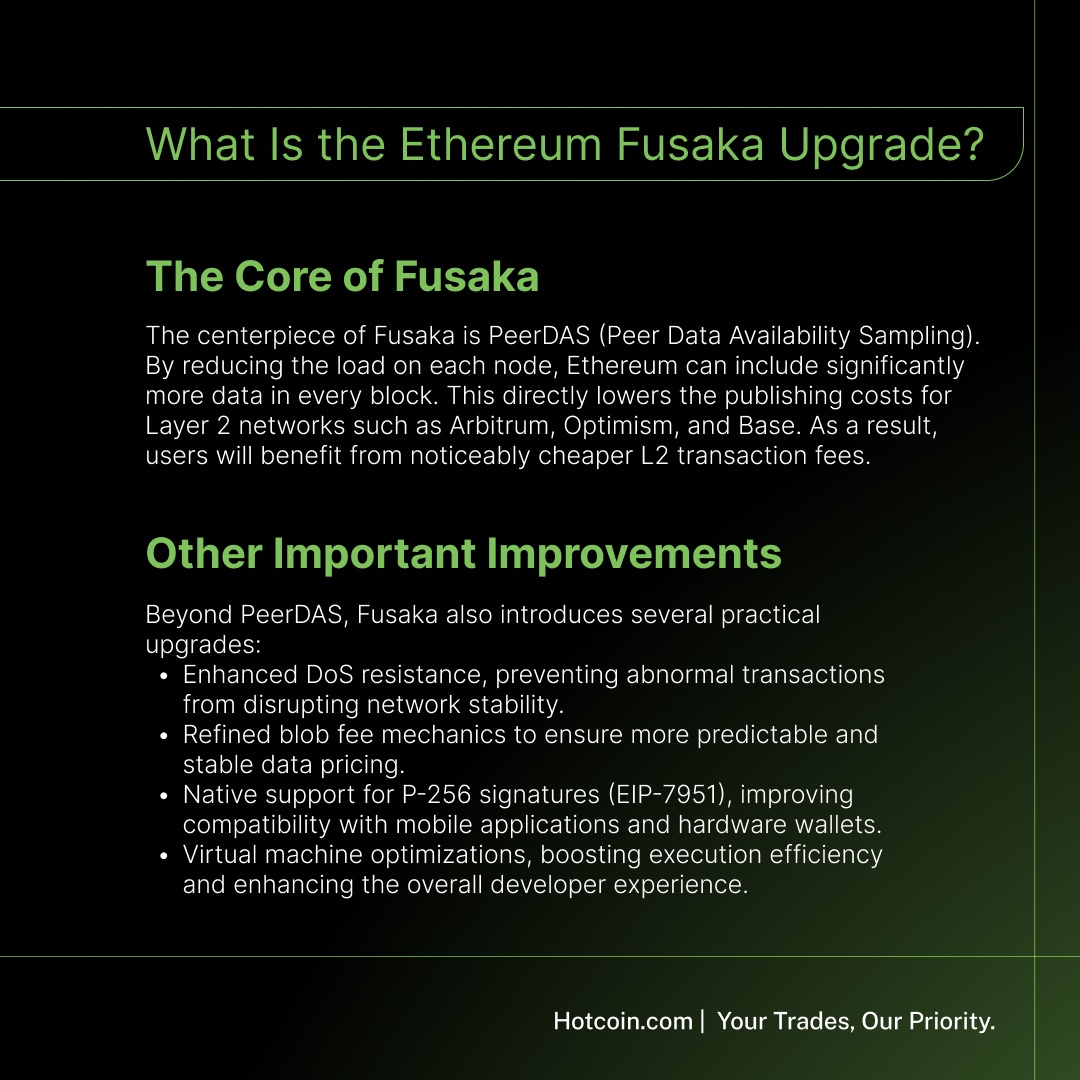
Ethereum is set to launch a major technical upgrade in December, known as Fusaka.
This upgrade aims to make Ethereum faster, cheaper, and more secure, preparing the network for broader adoption in the future. It is one of the most important milestones following the 2022 Merge and the 2023 Shanghai upgrade.
The Core of Fusaka: Reducing Node Load and Lowering L2 Costs
The centerpiece of Fusaka is PeerDAS (Peer Data Availability Sampling). Previously, Ethereum nodes had to store entire blocks of transaction data, creating a heavy resource burden. With PeerDAS, each node only needs to store about one-eighth of the data, while the rest is reconstructed through sampling.
By reducing node load, Ethereum can include far more data in every block. This directly lowers the cost for Layer 2 networks (such as Arbitrum, Optimism, and Base) to publish data. As a result, users will see significantly cheaper L2 transaction fees.
In essence, Fusaka enhances Ethereum’s scalability while reducing costs for everyday users.
Other Important Improvements
Beyond PeerDAS, Fusaka includes several practical upgrades:
-
Enhanced DoS protection, preventing abnormal transactions from disrupting network stability.
-
Improved blob fee mechanics, offering more predictable and stable data pricing.
-
Native support for P-256 signatures (EIP-7951), significantly improving compatibility with mobile wallets and hardware wallets.
-
Virtual machine optimizations to enhance execution efficiency and improve the developer experience.
Together, these upgrades strengthen Ethereum’s performance, security, and usability—supporting long-term scalability and ecosystem growth.
The Impact of Fusaka for Ethereum
In the short term, market reaction may be limited, as the upgrade has already been widely anticipated. ETH price movement remains driven primarily by macro liquidity conditions, ETF flows, and overall institutional sentiment.
However, the long-term impact of Fusaka is substantial. By expanding Ethereum’s data capacity and significantly reducing operating costs, the upgrade strengthens the network’s ability to support more users, more applications, and more economic activity. This positions Ethereum for broader adoption and stronger ecosystem growth in the coming years.
Summary:
The Fusaka upgrade makes Ethereum lighter, faster, cheaper, and more resilient — a critical step toward realizing its long-term vision of becoming the global settlement layer for decentralized finance and on-chain applications.
Recommended
View more

Service@hotcoin.com
Product@hotcoin.com
Business@hotcoin.com
Casecn@hotcoin.com