
What Is a Perp DEX?
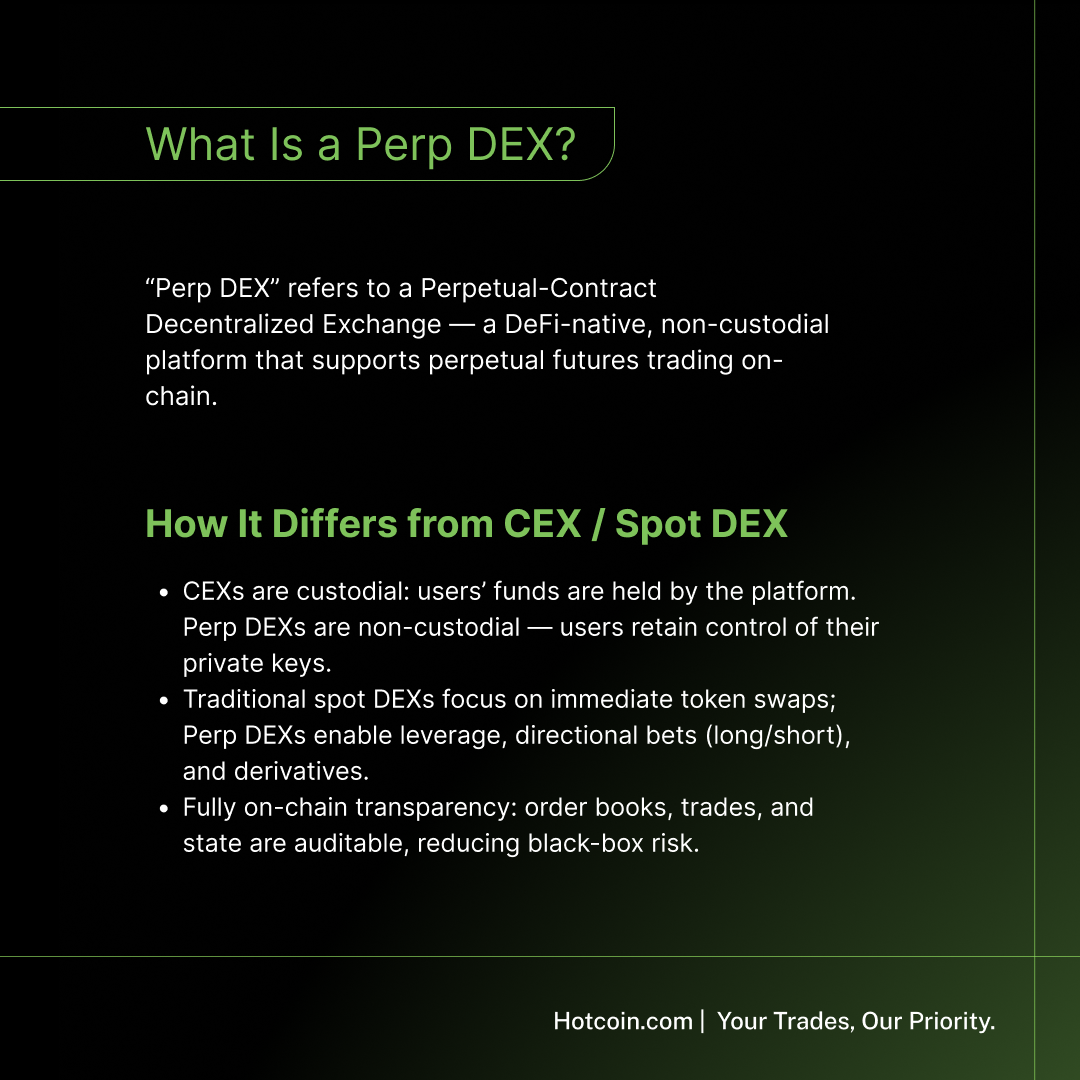
“Perp DEX” refers to a Perpetual-Contract Decentralized Exchange — a DeFi-native, non-custodial platform that supports perpetual futures trading on-chain.
-
Perpetual Contracts — Basics
-
A perpetual contract is a derivative without an expiration date, allowing indefinite holding of long or short positions.
-
Uses a funding rate mechanism to keep the contract price aligned with the underlying index.
-
-
How It Differs from CEX / Spot DEX
-
CEXs are custodial: users’ funds are held by the platform. Perp DEXs are non-custodial — users retain control of their private keys.
-
Traditional spot DEXs focus on immediate token swaps; Perp DEXs enable leverage, directional bets (long/short), and derivatives.
-
Fully on-chain transparency: order books, trades, and state are auditable, reducing black-box risk.
-
-
Matching & Liquidity Architecture
-
Can use on-chain order books, AMMs, or hybrid models.
-
Advanced designs may include RFQ (quote-request), cross-chain liquidity aggregation, and capital reuse to boost efficiency.
-
-
Leverage & Capital Efficiency
-
High leverage support (e.g. 50×, 100×) is common.
-
Some platforms allow yield-bearing assets (e.g. liquid staking tokens or interest-bearing stablecoins) as collateral, improving capital utilization.
-
-
Risks & Challenges
-
Liquidation risk: extreme price swings may trigger forced liquidation.
-
Funding rate bleed: holding positions long term may incur funding costs.
-
Slippage / liquidity dips: large orders may move price significantly.
-
Wash-trading / data integrity: some projects might artificially inflate volume, undermining trust.
-
Smart contract / governance vulnerabilities: bugs or governance flaws may cause losses.
-
-
Case Studies: Hyperliquid & Aster
-
Hyperliquid: a veteran in the Perp DEX space, built on a custom high-performance chain aiming for low latency matching and high capital efficiency. It has accumulated perpetual trading volume in the multi-trillion USD range.
-
Aster: an explosively rising competitor, boasting features such as multi-chain support, hidden orders, and high leverage.
-
-
Trends & Outlook
-
New entrants and centralized venues are racing into the Perp DEX space, viewing it as a frontier for on-chain trading.
-
The future winners will likely differentiate via transparency (verifiable data), capital efficiency, liquidity depth, risk control / protocol robustness, smart contract security, and community governance.
Recommended
View more



Service@hotcoin.com
Product@hotcoin.com
Business@hotcoin.com
Casecn@hotcoin.com