
Common Pricing Mechanisms for Cryptocurrencies: Order Book vs. Automated Market Maker (AMM)
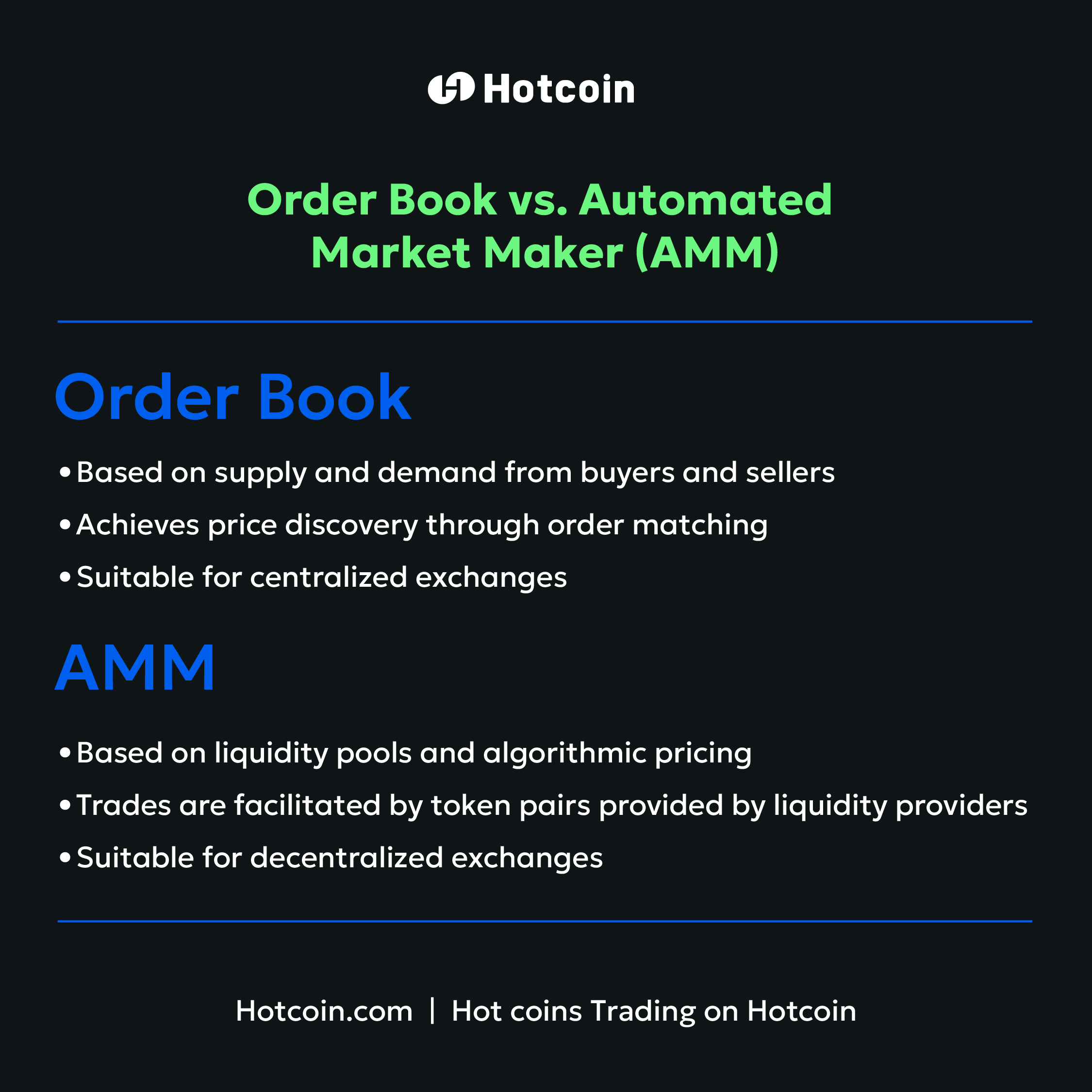
The primary pricing mechanisms for cryptocurrencies include Automated Market Makers (AMM) and Order Books. These are the main systems used for price discovery in decentralized and centralized exchanges.
1. Order Book Pricing Mechanism
The order book is a widely used trading mechanism in traditional financial markets and is also adopted by many centralized cryptocurrency exchanges (such as Binance, Coinbase, etc.). The order book forms prices based on the demand from buyers and sellers in the market. Its main features include:
Bid and Ask Matching: Users can place buy orders (bids) or sell orders (asks), and the exchange matches prices and quantities. Higher bid prices are prioritized, as are lower ask prices.
Limit Orders and Market Orders: Users can set limit orders, which only execute at a specific price, or market orders, which execute immediately at the current market price.
Price Determined by Supply and Demand: Prices on the order book are determined by the depth of buy and sell orders in the market. The gap between the highest price a buyer is willing to pay and the lowest price a seller is willing to accept is known as the bid-ask spread.
The order book model typically has high liquidity, making it especially suitable for large transactions and complex financial products.
2. Automated Market Maker (AMM) Pricing Mechanism
AMM is a common pricing mechanism used in decentralized exchanges (such as Uniswap, SushiSwap, etc.), which does not require the matching of buy and sell orders. Instead, it relies on smart contracts for pricing and trading. Its main features include:
Liquidity Pool: AMM depends on liquidity pools, where users can deposit two or more types of tokens as liquidity providers (LPs). These tokens are used for trading, and buyers and sellers exchange through the tokens in the pool instead of directly trading with another user.
Pricing Formula: The AMM pricing mechanism is algorithm-driven, with the most common being the "constant product formula" (x * y = k), which keeps the product of the quantities of two tokens constant. When a user buys one type of token, the quantity of the other token in the pool decreases, causing the price to rise, and vice versa.
Slippage and Price Impact: Since AMMs do not have the traditional price matching system of order books, prices are automatically adjusted based on the asset ratios in the liquidity pool. Large transactions can lead to slippage, which is the difference between the expected price and the actual execution price.
The AMM model simplifies the trading process, making it particularly suited for decentralized environments. However, it has greater price volatility and can be more susceptible to manipulation in low-liquidity situations.
Recommended
View more

service hotcoin.com
producthotcoin.com
businesshotcoin.com
casecnhotcoin.com